
Have a Question?
Learning from Crime Scene Investigations
Luke Taylor • November 22, 2026
Critical Thinking in every workplace...
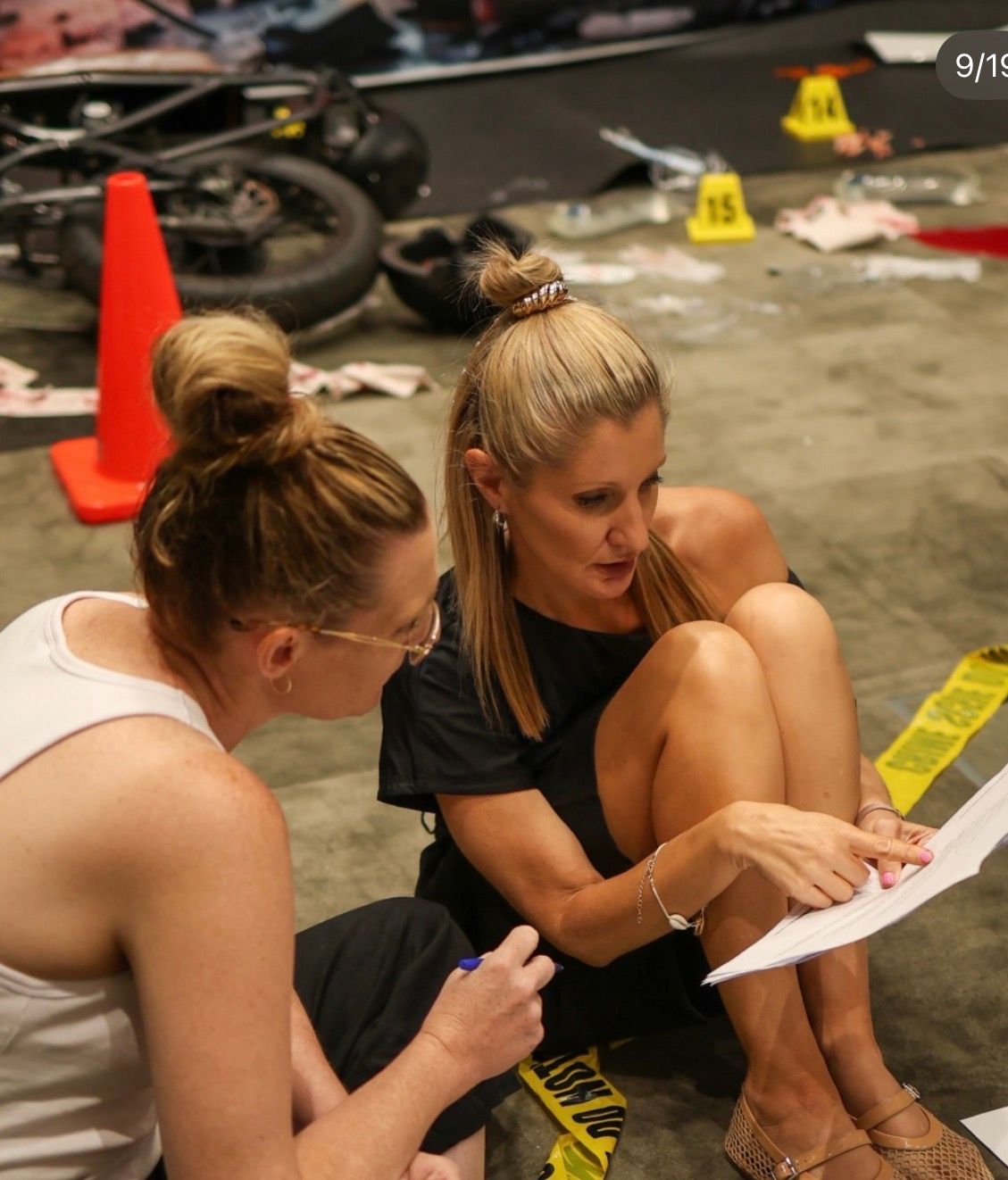
Critical Thinking at Work: Lessons from the Crime Scene
By Luke Taylor, founder of Crime Story and Australia Day Ambassador 2026 and 2027
Every workplace says it wants critical thinkers. Job ads ask for them, leadership programs promise to build them, and performance reviews reward them. Yet very few organisations can say how they actually train the skill.
For the past three years, Crime Story has been working with companies to answer that question in an unusual place: a crime scene.
Why a crime scene?
A crime scene is the perfect training ground for thinking. There is too much information and not enough certainty. Some of the evidence matters, some of it is noise, and some of it is quietly misleading. Decisions have to be made with incomplete facts, and the people making them have to work together.
That is also a fair description of most Monday mornings.
Our workshops put teams inside an immersive, true crime investigation. They find evidence, question assumptions, build theories and test them against what is in front of them. The mystery is the vehicle. The real subject is how people think when it matters.
We have seen the approach land in many settings, including with the property management team at Laing+Simmons. Their head of property management, Michael Anania, recognised that property managers need a wide mix of skills to solve problems and meet the expectations of a demanding market, and he wanted hands-on training that reflected that. The team investigated a crime scene, reviewing evidence and sharpening attention to detail and analytical skills they take straight back to their day jobs. They have since planned to return to solve another "crime". You can read the coverage in industry press and on LinkedIn.
Laing+Simmons is one of many. Over three years we have trained workplaces from Canberra, Sydney, Brisbane and the Gold Coast, and teams in every city have left empowered to make better decisions. One professional from IRIA, a national company, put it better than we could. At 60 years old, they told us: "That is the best day I've had at work in sixty years."
But what is it, specifically, that makes this training work? After three years, we can name the ingredients.
1. Understanding what "critique" really means
Most people hear "critical thinking" and quietly translate it to "finding fault." That is a mistake, and it makes people defensive before the thinking even starts.
The word critique comes from the Greek krinein: to separate, to discern, to judge carefully. A critique is not an attack. It is a careful weighing of what is strong, what is weak and what is simply unknown.
In our workshops, teams practise critiquing evidence, and then critiquing their own theories. Does this fingerprint actually prove what we think it proves? What would we expect to see if we were wrong? When critique becomes a shared, curious habit rather than a personal threat, teams get braver about testing ideas. That is the foundation everything else sits on.
2. A real-time feedback loop
Most workplace learning has a long delay built in. You attempt something, and weeks later a review tells you how it went. By then the moment is gone.
An investigation compresses that cycle into minutes. A team forms a theory, checks it against the scene, and immediately finds out whether it holds up. Wrong turns are cheap, visible and quickly corrected. Good reasoning is reinforced on the spot.
This matters because critical thinking is a practised skill, not a piece of knowledge. People improve when they can see the link between how they reasoned and what happened next. We build the session so that link is constant, and so that people leave knowing how to create the same loop at work: shorter check-ins, earlier questions, faster course corrections.
3. Knowing your own context and perspective
Two people can stand in the same room, look at the same evidence and see different stories. That is not a flaw in one of them. It is how perception works.
Every one of us interprets information through our experience, our role, our expertise and our assumptions. A finance specialist, a property manager and a teacher will each notice different things first. In the workshop, teams discover this for themselves when their readings of the same clue diverge, and the questions that follow are the valuable part: Why did I see it that way? What am I bringing to this that someone else isn't?
Once people can name their own lens, they can hold it more loosely, and they start to value the lenses around them.
4. Emotional intelligence: reading your own state of mind
This is the part that surprises people most. Critical thinking is not purely rational. How we reason depends heavily on how we feel while we do it.
When we are stressed, rushed, excited or defensive, we process information differently. We grab the first plausible answer. We cling to a theory because we've invested in it. We skim the detail that contradicts us. Detectives learn to notice this in themselves, because a compromised state of mind compromises the case.
So we train people to check in with themselves before they weigh important information. What is my state right now? Am I calm enough to judge this well, or do I need a moment, or a second pair of eyes? That small pause is a professional skill, and it is one of the most underrated in the modern workplace.
5. Relying on your team
The final ingredient follows naturally from the first four. If you know your perspective is partial, and your state of mind affects your judgement, then the sensible response is to lean on other people.
No single investigator holds the full picture. Strong teams deliberately split up the work, share what they see, challenge each other respectfully and pressure-test conclusions before committing to them. In our workshops, the teams that do best are rarely the ones with the single sharpest individual. They are the ones that communicate clearly, trust each other's observations and treat disagreement as information.
That translates directly to the workplace. Better decisions come from groups that have learned how to think together.
What organisations take back
It would be easy to dismiss a crime scene workshop as a fun team-building day, and it is fun. But the skills underneath are the ones businesses depend on every day:
- Noticing what matters in a flood of information
After three years of working with companies, schools and universities, our conviction has only grown: critical thinking is not a talent some people have and others don't. It is a set of habits, and habits can be trained.
- Noticing what matters in a flood of information
- Questioning assumptions, including their own
- Making and testing decisions quickly with feedback
- Staying aware of their own mindset under pressure
- Drawing on the strengths of the people around them
The best place to start might just be a room where something has gone wrong, the clues are on the table and the whole team has to work out what happened.
Crime Story delivers immersive crime scene investigation workshops for corporate teams, schools and universities across Australia. Find out more at crimestory.com.au.
.
Educational Packages
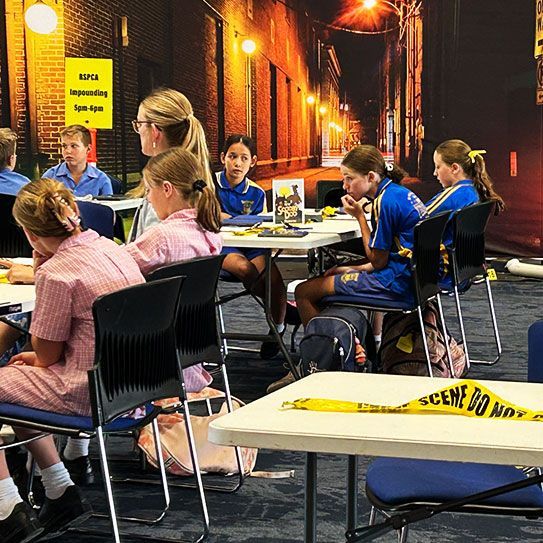
Unlock a world of discovery with our Educational Packages, where students collaborate with a former detective and experienced teacher to embark on captivating investigations aligned with essential syllabus elements. These interactive workshops not only spark curiosity but also enhance critical thinking and teamwork, offering students a chance to explore their interests in a dynamic learning environment. We provide workshops designed for schools anywhere in Australia. Dive into our diverse offerings below to find the perfect fit for your classroom.
Corporate Team Building
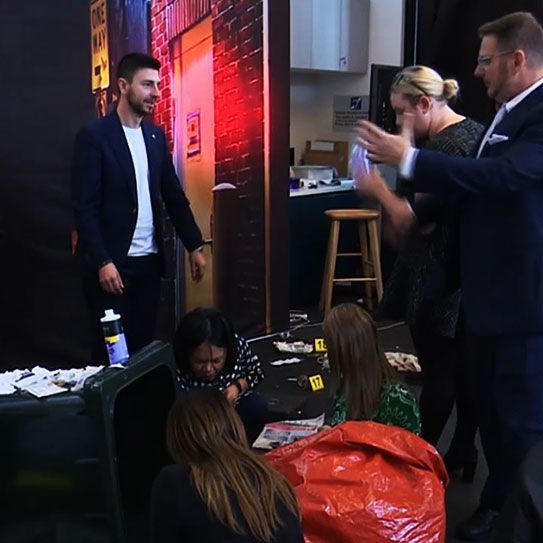
Transform your corporate team building experience with an engaging Crime Story Corporate Team Building Event. Whether for a small team or a large corporate retreat, our customised crime scene investigations encourage teamwork, problem-solving, and the development of essential soft skills in a fun, interactive environment. Forensic team building events bring your team closer together as they uncover clues and navigate through real-life mysteries, all while enhancing morale and building stronger connections.