
Have a Question?
AI alternative to teach writing
Luke Taylor • July 22, 2026
High School boys don't like writing?
Inside the Crime Scene: How Crime Story's Workshops Are Pulling Students Away from the AI Shortcut.
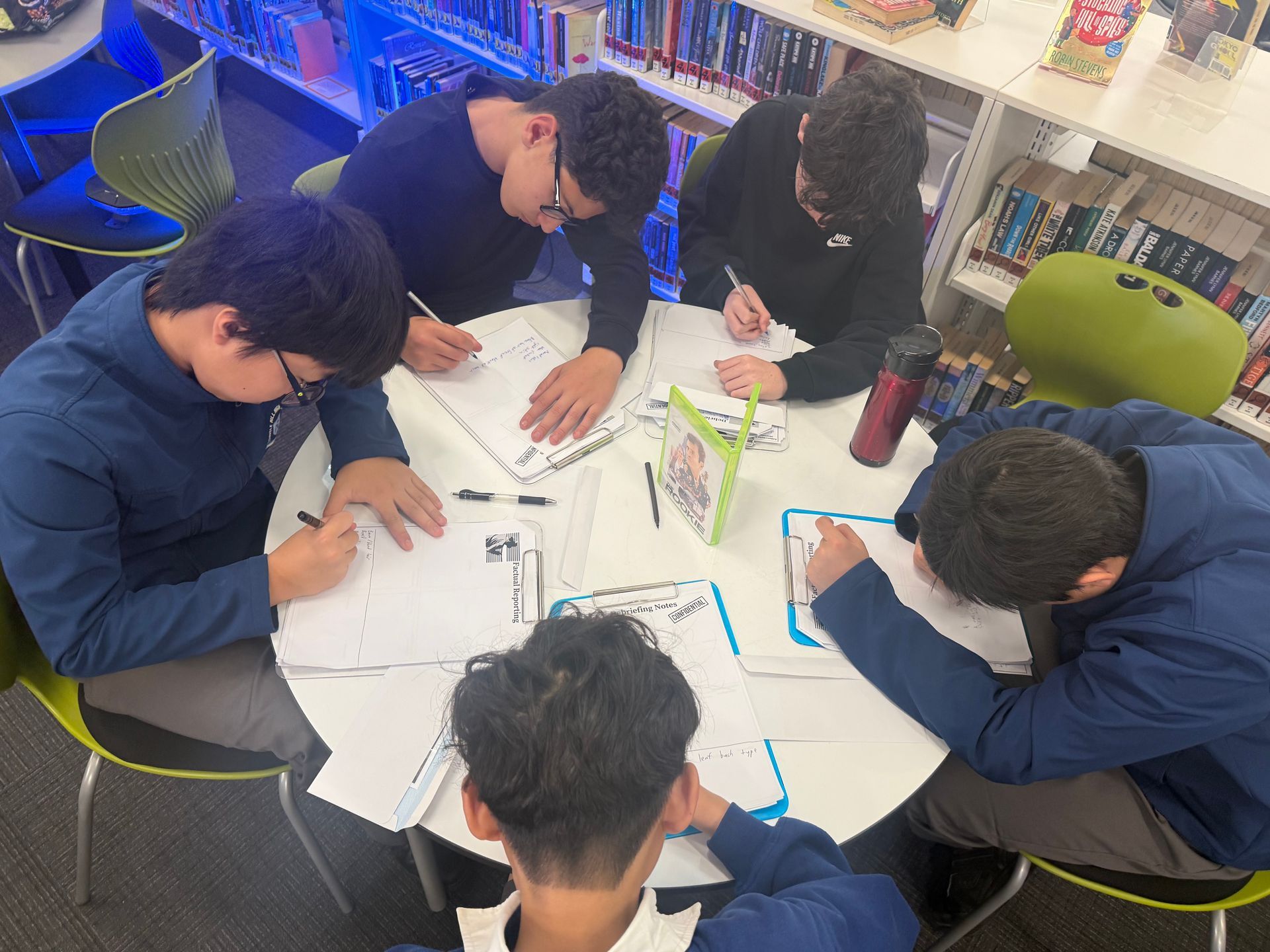
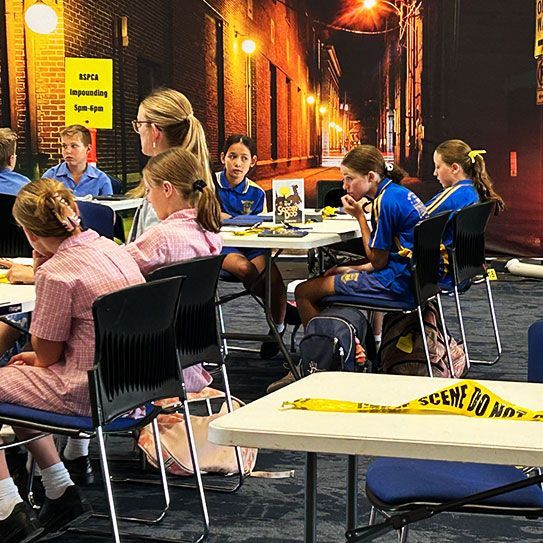
Walk into a Crime Story session and the first thing you notice isn't a whiteboard or a laptop screen: it's a crime scene. Two large, digitally printed backdrops, each roughly six metres by two, dressed with a mix of real and simulated evidence: shell casings, fingerprints, DNA swabs, a cracked safe. Students pull on gloves, work through evidence bags, and start asking questions before anyone has mentioned a single narrative technique. The writing lesson starts later. The experience comes first.
Crime Story is an Australian program run by Luke Taylor, a former detective who is now an HSC English teacher with a Master of Arts in Writing. His workshops run in schools and universities across the country, built around the idea that students learn to write compelling narrative by first learning to investigate: asking the right questions, handling evidence, and untangling a scene the way a detective would, before ever putting a sentence down.
Built on lived experience, not secondhand description
The program's own account of its origin is telling: Taylor describes turning to postgraduate study in writing to reignite a creative spark that had faded under the weight of standard curriculum demands, and using that study: across crime, children's literature, and popular culture: to open up new ways of teaching narrative in the classroom. The workshops that came out of that are explicitly framed around transferable skills: students aren't just learning to write a crime scene, they're learning to investigate, question, and build a case, skills the program argues carry over into research, evaluation, and any writing task that asks for authenticity.
The flagship school programs: "Writing Unleashed" for Years 7 to 11, and a dedicated Craft of Writing workshop for Year 11 and HSC students: both follow the same basic shape. Students physically move through interconnected crime scenes (an armed robbery at a diner, a trashed office), working alongside Taylor as what the program calls a "literary detective." Along the way they're taught procedural narrative, sensory imagery, lexical chaining, framing, and how to build authentic dialogue and indirect characterisation: the actual craft vocabulary of the HSC syllabus: but taught through evidence in front of them rather than through an abstract worked example on a slide.
Where the case against AI shortcuts fits in
Crime Story doesn't market itself with the words "instead of AI." But its whole pedagogical bet runs directly against the thing generative AI is best at: producing a plausible-sounding scene with no actual experience behind it. A student who has crouched over a mocked-up crime scene, handled a real forensic kit, and had to decide in the moment which piece of evidence actually matters has something in their writing that's hard to fake: a specific, sensory, slightly disorganised sense of what it's like not to know the ending yet. That's the exact quality that generic, prompt-generated scene description tends to flatten out, because a model has no scene of its own to draw on, only a pattern for what scenes like that usually sound like.
One teacher's feedback, quoted on Crime Story's own site, gets at this directly: the appeal, she noted, was that the format could generate endless writing scenarios simply out of lived experience tailored to whichever students she was teaching. That's the crux of the pitch: not "write about a crime scene" as an assignment, but "here is a crime scene, now write about the one you actually just stood in."
What the structure is actually teaching
Underneath the theatrics, the workshop structure targets specific, examinable syllabus outcomes: NESA rationale points around imaginative and critical thinking, effective text response, and confident, creative language use. In practice, that comes through in a few concrete ways:
- Evidence over exposition. Because students are sorting real and simulated exhibits themselves, they're forming their own theory of the scene rather than receiving one, which pushes them toward original description instead of borrowed genre shorthand.
- Questioning as a writing skill. The program treats "asking the right questions" as a craft technique in its own right, not just an investigative one: the same instinct that produces indirect characterisation and a well-placed narrative gap.
- Reflection built into the process. HSC sessions close with reflection statements and a live "hot seat" feedback session on real writing samples, tying the immersive experience back to the exact kind of self-aware craft commentary the exam expects.
- Adaptability without losing the core. The program explicitly imagines the same techniques feding into video games, comics, film, and documentary: the crime scene is a vehicle for narrative thinking generally, not a genre exercise for its own sake.
The honest limits.
None of this makes AI tools irrelevant to a student's process, and Crime Story's own material doesn't claim otherwise: the emphasis is on where narrative comes from, not on banning any particular tool. A student can still use AI to tidy grammar or brainstorm structure. What a workshop like this is protecting against is something narrower: the temptation to skip the step of actually having something to say, and go straight to generating text that sounds like it. Crime Story's answer to that is blunt and low-tech: put the student in the room with the evidence first, and let the writing follow from there.
There's also a practical constraint worth naming. Live, staged, forensic-kit-equipped workshops don't scale the way an app does, which is presumably part of why Crime Story emphasises its mobile, regionally-based delivery model: an explicit effort to get this kind of experience to rural and coastal schools as well as city ones, rather than leaving it as a city-only offering.
It's bigger than one program.
Taylor himself is careful to frame this as more than a pitch for his own workshops. Alongside running Crime Story, he delivers professional development sessions for teachers, writers, and corporate groups, and the message he pushes hardest in those sessions isn't "book Crime Story." It's that anyone teaching or leading a room should go and build their own version of experiential learning, in whatever form fits their subject or team. His point is that the format matters less than the principle: the more educators are willing to put people inside an experience rather than just describing one to them, the better the resulting work gets. This isn't a case for one company's crime scenes so much as an argument for a whole different way of teaching craft.
The through-line.
Strip away the shell casings and the digitally printed backdrops, and the underlying claim is an old one, freshly staged: narrative craft strengthens when it's built out of something a writer actually went through, however small or simulated, rather than assembled from what similar scenes usually sound like. Crime Story is betting that a room, some fake blood, and forty-five minutes of genuine uncertainty will always give a student writer more to work with than a well-phrased prompt ever could.
Educational Packages
Unlock a world of discovery with our Educational Packages, where students collaborate with a former detective and experienced teacher to embark on captivating investigations aligned with essential syllabus elements. These interactive workshops not only spark curiosity but also enhance critical thinking and teamwork, offering students a chance to explore their interests in a dynamic learning environment. We provide workshops designed for schools anywhere in Australia. Dive into our diverse offerings below to find the perfect fit for your classroom.
Corporate Team Building
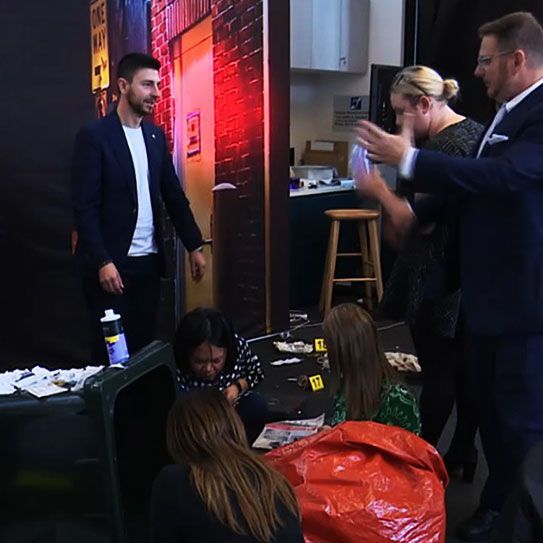
Transform your corporate team building experience with an engaging Crime Story Corporate Team Building Event. Whether for a small team or a large corporate retreat, our customised crime scene investigations encourage teamwork, problem-solving, and the development of essential soft skills in a fun, interactive environment. Forensic team building events bring your team closer together as they uncover clues and navigate through real-life mysteries, all while enhancing morale and building stronger connections.